

In this Parliamentary One-Pager (POP) launched in the House of Lords on 3rd February 2026 I make the case for an AI Bill. The UK urgently needs an approach to AI that puts humans in charge and humanity at the heart. It can, and must, be pro-innovation, pro-investment, pro-consumer, pro-creative, pro-citizen rights.
The Current Approach:
Since 2016, consecutive Governments have concluded that the UK does not need any specific sector or economy-wide AI legislation. This piecemeal and fragmented approach has placed the regulatory burden on domain specific regulators without the capacity, expertise, or, it seems, enforcement tools or incentives, to meaningfully regulate AI.
Not only is this lack of clarity, consistence and coherence harming individuals and hampering growth, it is not what the public want. Recent research from the Ada Lovelace Institute found the current approach is “increasingly out of step with public attitudes”.
Indeed, the Government have themselves indicated that targeted primary legislation is required for, amongst others: frontier AI, IP and copyrighted works, the AI growth lab and AI chatbots. So according to the Government there will be no cross sector legislation and no domain specific legislation but legislation is needed.
How and where will it come from?
Copyright and IP:
One critical issue the Government are considering is how to protect (or not) creators’ copyright and IP in the AI Age. Despite a series of consultations and battles in the House of Lords, Ministers recently insisted that they haven’t made a decision yet and describe this as a “genuine reset moment”. They also suggested that it had been a mistake to start the consultation with a preferred model and that there will be more working group meetings in February 2026.
In a new report, Brave New World, groups representing authors, illustrators, musicians, performers and photographers said creators’ incomes were being eroded in an increasingly AI-driven world, and proposed a five-point regulatory framework designed to prevent the creative economy’s complete collapse.
Compiled by the The Society of Authors, The Association of Illustrators, the Independent Society of Musicians, Equity UK, and the Association of Photographers, the report was clear that while “generative AI is being sold as a major driver of the fourth industrial revolution” the UK had suffered the “industrial scale theft” of its cultural riches as AI developers trained their models on “human-made works without permission, payment or even acknowledgement”.
There is strong support from creative organizations and a recent IPPR report, AI’s got news for you, for government action to rebalance power and set clear, strong UK rules that preserve rightsholders’ leverage and avoid harmful exceptions. My AI (Regulation) Bill would strengthen obligations around transparency, labelling, auditing, and use of IP and copyrighted works.
Support for the POP
I opened the launch event by setting out my case for a single, cross-economy bill grounded in human rights and principles-based governance and invited responses and reactions from the group.
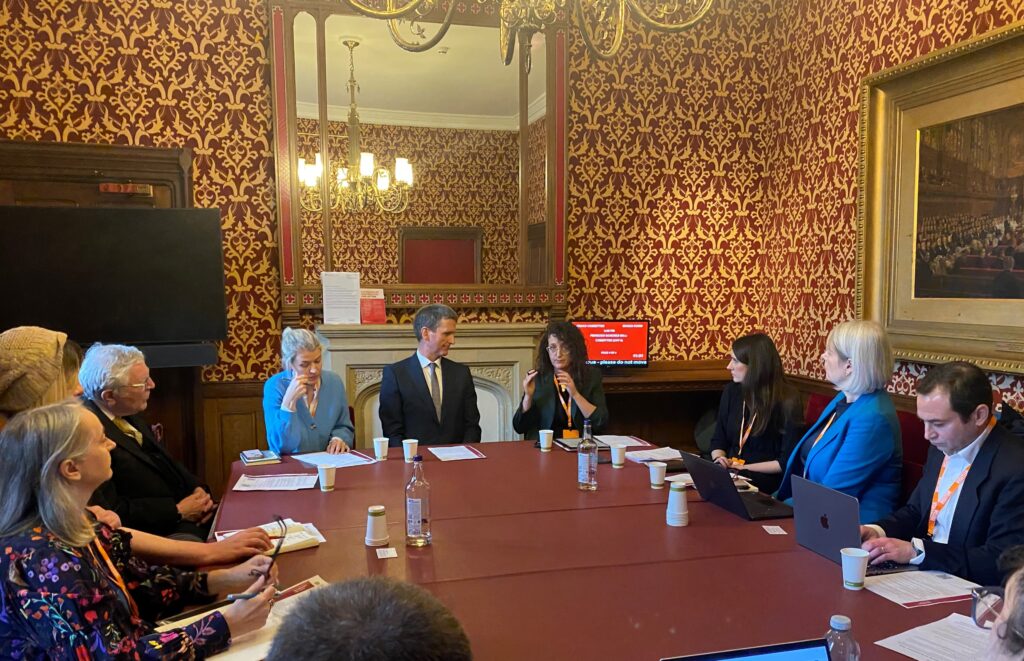
Gaia Marcus, Director at the Ada Lovelace Institute, warned that wait-and-see inevitably becomes whack-a-mole. Erin Young from the Institute of Directors reframed the conversation pointing out effective governance isn’t a brake pedal, it’s how boards give companies strategic direction. Hannah Perry of Demos made a compelling case that AI could be part of a new social contract between state and citizen, but only if we break out of the “democratic doom loop” with concrete protections like a declaration of digital rights. Professor Gina Neff, Executive Director at the Minderoo Centre for Technology and Democracy focused on what joined-up policy actually means, suggesting that “the AI Opportunities Action Plan is not a plan for most of us, it is the tech sector’s 50-point laundry list, not a strategic policy framework. We’re seeing the consequences of fragmented thinking already.” Jeremy Khan, author and journalist at Fortune Magazine, spoke about the need to build sovereign capacity. Lord (Tim) Clement-Jones who has also introduced a Private Members Bill on AI, the ‘Public Authority Algorithmic and Automated Decision-Making Systems Bill’ shared his thoughts.
I am grateful for these perspectives and the participation and support of colleagues and experts in this field. We can, and must do better, but leadership requires choosing a coherent legislative path over piecemeal improvisation.
Building Regulatory Capacity
A key part of my argument is that the current approach has resulted in fragmentation and uneven application. Multiple regulators (domain‑specific but not AI‑expert or experienced) in reality look like no competent regulator at all. In 2024 the Department of Science, Innovation and Technology identified thirteen regulators to take “strategic approaches” to AI oversight. The Digital Regulation Cooperation Forum (DRCF) is a collaborative initiative that brings together four UK regulators dealing with digital services and AI: the Information Commissioner’s Office (ICO), the Competition and Markets Authority (CMA), the Financial Conduct Authority (FCA) and the Office of Communications (Ofcom).
The day after my POP was launched the Joint Committee on Human Rights heard from three regulators (the Equality and Human Rights Commission (EHRC), the ICO and Ofcom) about the fast-growing impact of AI on people’s rights. Each regulator emphasized that while they already oversee important aspects of AI (such as equality, privacy, and online safety) the pace of technological change is outstripping the speed of traditional regulation. They also highlighted serious concerns ranging from biased algorithms to gaps in oversight, especially where AI is deployed in sensitive areas like policing, welfare, and social media.
A recurring theme was capacity. Regulators face resource constraints, most starkly the EHRC, which has operated on a frozen budget for over a decade, while trying to keep up with increasingly complex technologies. Despite this, all three regulators stressed their commitment to collaboration through forums like the DRCF and their increased investment in technical expertise. They also described new powers on the horizon, such as the ICO’s ability to compel technical audits under the Data (Use and Access) Act, which they hope will strengthen oversight of high‑risk AI systems.
Across the session, witnesses made clear that the UK’s regulatory landscape needs to adapt quickly to maintain public trust. Issues such as biased facial recognition, AI‑driven misinformation, and age assurance for children are already testing the limits of current laws.
This lack of capacity and incredible pressure to adapt underlines the need for regulators to be properly resourced, empowered, and coordinated. I have argued for, and my AI (Regulation) Bill would establish, a statutory, horizontally focused AI Authority to coordinate regulators, identify gaps, and monitor systemic AI risks. An independent regulator is supported by 89% of the public as highlighted by the Ada Lovelace Institute.
Conclusion
A wait and see, voluntary, partial domain-specific approach can no longer be accepted. It fails to enable, empower, and optimize the UK AI opportunity. As importantly, it is not what the public want. There is an economic, a social, and a psychological imperative to act. We need a cross-cutting, principles-based, outcomes-focused AI Bill. It’s time to legislate, together on AI. It’s time to human lead. Our data, our decisions, our AI futures.
Related news:
Business and policy leaders join peers in renewed call for cross-industry AI legislation, Computing, Penny Horwood
‘Complete nonsense’ to choose between AI innovation and regulation, says U.K. lawmaker | Fortune
Related posts:
AI Regulation Report – Lord Holmes of Richmond MBE
Artificial Intelligence (Regulation) Bill – Lord Holmes of Richmond MBE (lordchrisholmes.com)
AI Bill – UK Leadership on AI Regulation – Lord Holmes of Richmond MBE (lordchrisholmes.com)
AI Bill – Ethical AI – Lord Holmes of Richmond MBE (lordchrisholmes.com)
AI Bill – Second Reading Debate – Lord Holmes of Richmond MBE (lordchrisholmes.com)
AI Bill – IP and Copyright: Clause 5 – Lord Holmes of Richmond MBE
AI Bill – Regulatory Capability – Lord Holmes of Richmond MBE (lordchrisholmes.com)